




For travelers captivated by Southeast Asia and the majestic beauty of Northwest Vietnam, conquering Fansipan – the roof of Indochina – is considered the pinnacle of exploration.
Vietnam doesn't have a mountain that symbolizes the entire nation like Mount Fuji in Japan or the Matterhorn in Switzerland… But if we were to choose a mountain that Vietnamese people could proudly tell stories about, it would undoubtedly be Fansipan – the highest peak in the three former Indochinese countries (Vietnam, Cambodia, and Laos). It's no coincidence that Vietnamese people say, “Everyone has their own Fansipan,” to represent the greatest dream of a person's life.
Fansipan, in the local language, is also known as Hua Xi Pan, meaning “precariously perched giant rock.” According to the Vietnam Institute of Geoscience and Mineral Resources, the entire mountain is a majestic granite mass that emerged from deep within the earth over 250 million years ago. Northwest Vietnam is known for its challenging terrain, among the most difficult in Southeast Asia, but Fansipan is located in Hoang Lien Son – the range with the most complex terrain in this region. According to many documents, the Hoang Lien Son range is also the southeastern end of the majestic Himalayas.
The constant clouds and treacherous terrain have enveloped Fansipan in an enchanting and surreal beauty. Curiously, this beauty appears differently to each person. When the French first explored this area 120 years ago, they compared Sa Pa and its mountains to the famous European Alps. A Vietnamese person raised on folktales believes Fansipan is the gateway connecting heaven and earth. An adventurous traveler might see a resemblance to the majestic Himalayas. Regardless of the comparison, Fansipan, beyond its grandeur, offers a sense of familiarity and connection to each individual.
The difficulty once made conquering Fansipan's peak a challenge only for passionate, courageous, and physically fit individuals who could traverse the dense forest, spending 2-5 days and nights climbing, sleeping in the mountains, before reaching the summit. Many travelers considered reaching Fansipan a near-impossible dream. It was like a forgotten paradise, a promised land for many visitors who fell in love with Sa Pa but couldn't reach it due to the extensive travel time.
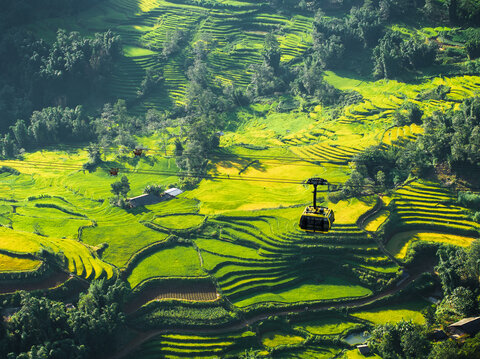
In 2016, the cable car system built by Sun Group and implemented by the world's leading cable car manufacturer, Doppelmayr Garaventa, opened up the opportunity to conquer Indochina's highest peak to travelers of all ages. The 2-7 day journey was reduced to a mere 15-20 minute cable car ride through the clouds.
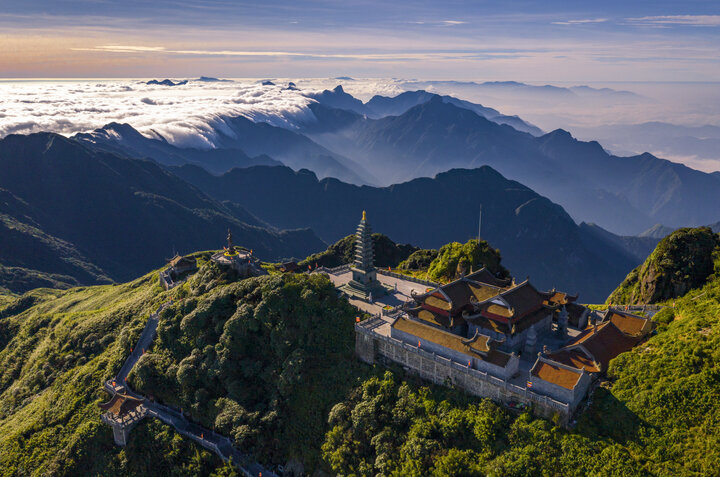
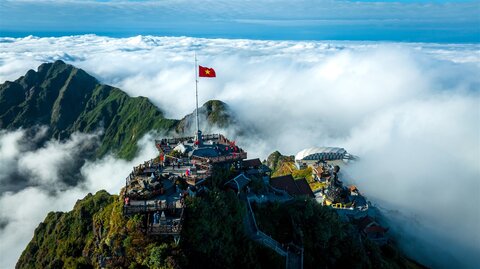
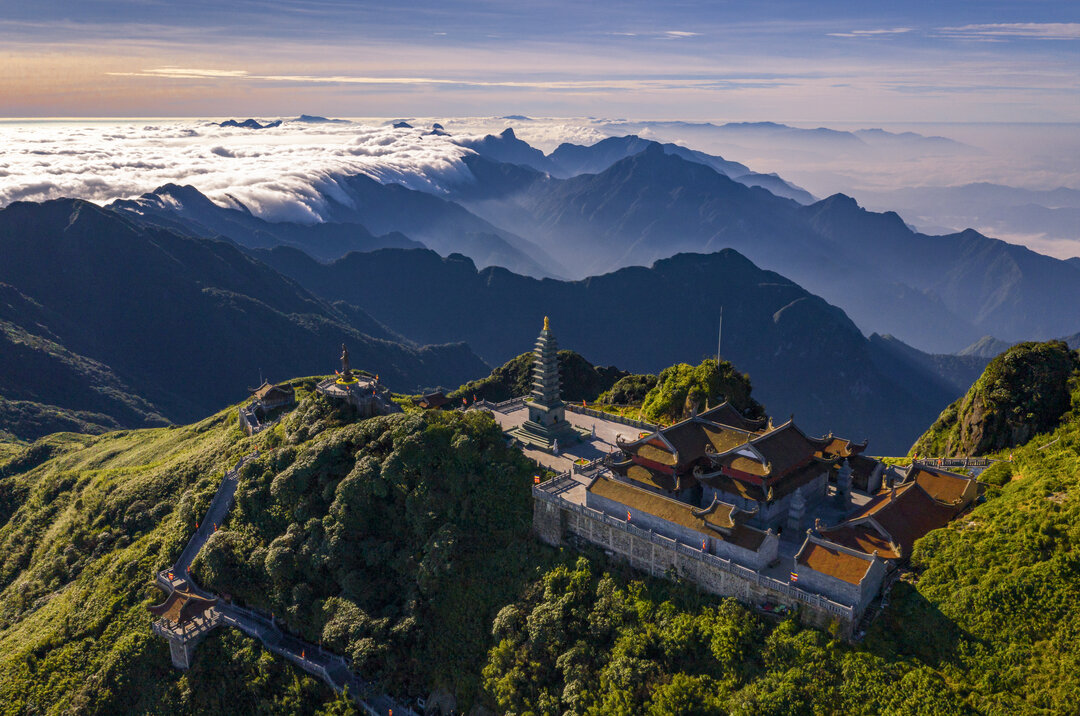
As the Fansipan cable car cabin doors open, travelers witness the earth and sky merging, with rolling clouds and sunlight brighter than anywhere else in Vietnam. And if you visit Fansipan on a cloudy day, you'll feel like you've traveled through time, in a half-real, half-dreamlike state, amidst the mist and clouds, where ancient Vietnamese temples from the 15th-16th centuries appear.
Fansipan's fame isn't solely due to its breathtaking natural beauty; it's also celebrated for its four distinct seasons and twelve months of vibrant blossoms. Many of these flowers have been painstakingly cultivated and nurtured by local tourism workers.
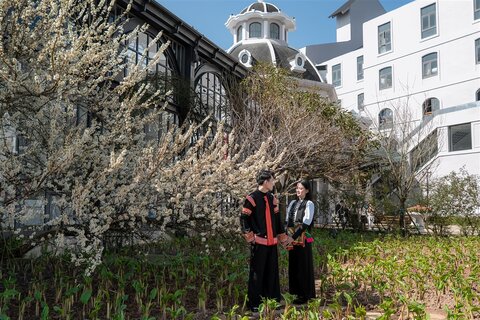
In spring on Fansipan, flowers bloom amidst the clouds, leading the way to the Heavenly Gate. Peach and Himalayan cherry blossom forests create a beautiful and serene spring palette amidst the majestic mountains and hills, where the morning dew gently awakens the birds. Spring is also when 300-400-year-old rhododendrons bloom vibrantly, adding intricate colors to the centuries-old mountain landscape.
Summer atop the mountain is a symphony of flowers and wind, as Vietnam's largest rose garden at Sun World Fansipan Legend dons a new red coat of climbing roses unique to Sa Pa. The slopes are also adorned with blooming Strychnos nux-vomica, beautiful like fluffy purple clouds in the sun and mist.
}Autumn on Fansipan is cloud-hunting season. At an altitude of 3,143 m, swirling clouds flow like rivers surrounding the sacred peak. The terraced rice fields cling to the mountain slopes like cascading golden waterfalls, pouring down from the clouds. In any area at Sun World Fansipan Legend, visitors can also see slopes of rice paddy flowers dyeing a captivating mountain region red. It is also autumn, also red, but this red is quite different from that of temperate countries.
In winter, the temperature on Fansipan peak can drop to -9 degrees Celsius, making it one of the few places in Southeast Asia where you can see ice and snow. Sometimes, the snow is more than half a meter thick, creating a magical scene like something from a beautiful Northern European fairytale.
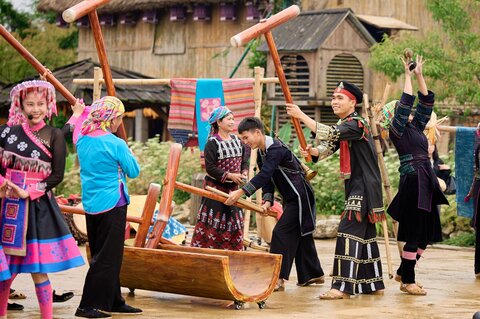
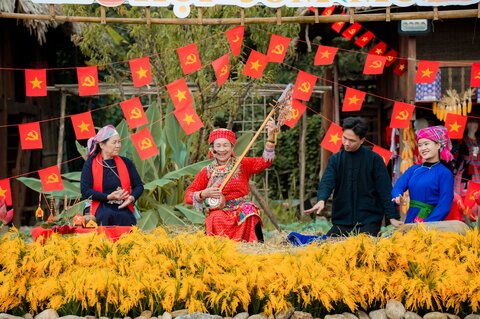
Choosing Fansipan as a destination is also choosing to explore Sa Pa - a place where the diverse colors of the Northwest Vietnam ethnic groups converge. There is a beautiful song describing the people of Sa Pa: “The sun rises from your cheeks,” referring to the radiance of the smiles of the Northwest children and their sunburnt rosy cheeks. Only when meeting the H’Mong, Giay, Tay, Dao, and Xa Pho ethnic people in the peaceful Northwest Cultural Space, resembling a small village at the foot of Fansipan Mountain, can visitors imagine the radiance of embracing the sun in their colorful brocade dresses. The sounds of lively Sap dances and poignant khen pipes also create uniquely Sa Pa sounds. These are the things that make visitors linger on this land.
Each time you visit Fansipan or Sa Pa, you will not find any repeated experiences. Because every moment, every season, Fansipan and Sa Pa have a very different, very unique beauty. For this reason, people call Fansipan a lifetime destination, a place to visit many times in a lifetime, because each time you visit the sacred peak - where people, mythology, and mountains coexist - you will find a different emotion, a different experience.